Six students from the Academy of Arts, University of Novi Sad, explore our connections with people, technology and nature through six works presented as part of the TEK.village exhibition.
We Are All Connected
What connects us to nature, to technology and to one another? A collective project by Serbian students from the Academy of Arts, University of Novi Sad, explores these questions through six works spanning interactive installations, sculpture, sound and digital experiences.
Presented as part of the TEK.village exhibition, the project brings together different perspectives under a shared idea: through the infrastructures of nature, society or the internet, we are all connected. The works invite us to notice the systems around us — including the invisible and often overlooked processes that shape our environment and our lives — and to consider how technology might change our relationship with ourselves and the living world.
The students developed their works under the mentorship of Sunčica Pasuljević Kandić, Associate Professor at the Academy of Arts, University of Novi Sad, and a member of the Translation Flowers collective, which is curating the TEK.village exhibition.
Six works, six ways of connecting
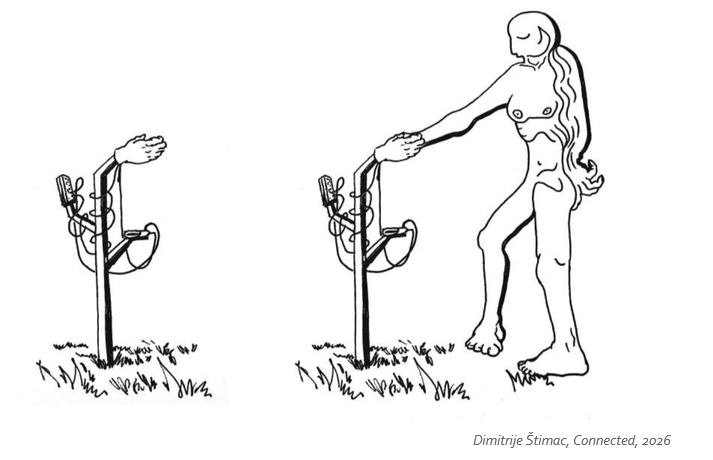
Dimitrije Štimac – Connection
Installed in Välitä-puisto, Connection uses a sensor, steel plate and vibrations to create a quiet, physical encounter with the surrounding landscape. By placing their left palm on the metal plate integrated into the sculpture, visitors can feel vibrations from the environment, reconnecting with nature through touch and technology.
Sara Trajer – Systems
This interactive web game transforms Elektroniikkatie into a landscape of clues and connections. Combining Google Earth, remote exploration, location-based play and “vibe coding”, Systems moves between screen and physical surroundings, encouraging visitors to question how technology observes, measures and shapes our experience of nature.
Itan Jan Katurov – Isn’t It Sad That Peace Feels Like It Must Be Earned?
In this hybrid AR installation, visitors encounter Yanche, an alien struggling with exhaustion and the pressures of toxic productivity. By scanning and carrying Yanche on their phone, participants enter an interactive story where their choices shape the relationship between them. At its heart, the work is an invitation to practise empathy — even towards a stranger.
Teodora Mirić – Forest of the Future
What might nature look like if plants themselves had to adapt to the consequences of human activity? Through aluminium foil and laser-engraved acrylic mirrors, Mirić imagines a future where plants evolve to survive mining, metals and industrial pollution. The work asks what happens to biodiversity and symbiosis when only the most resistant species survive — and who, ultimately, the future forest will exist for.
Radoš Manigoda – Anthem of Dystopian Community
This participatory sound work turns individual listeners into performers. Using QR codes and their own phones, visitors contribute separate fragments that combine into a larger anthem. The complete composition can only be experienced through collective participation, making the act of listening itself a demonstration of how individual actions create something shared.
Tara Nikolić – Fragmented Relations
Scattered along Elektroniikkatie, Nikolić’s small sculptural forms are made from differently processed jute threads. Branching, loosening and knotting along the edges of the road, the works evoke relationships that connect, break and leave traces behind. Visitors are invited to walk among them and reflect on their own fragmented connections.
Together, the six works ask us to slow down and look again: at the technologies surrounding us, at the natural systems we are part of, and at the relationships that hold communities together. They suggest that technology is not separate from nature or society, but another system through which we understand, influence and connect with the world.
This is only the beginning. Visit the TEK.village pop-up exhibition (11th-13th September) to see individual presentations of the six artworks, alongside works by other artists selected through the second open call for performative activations.
TEK.village
TEK.village is a free, family-friendly public art initiative and part of the official Oulu2026 European Capital of Culture programme, temporarily transforming Teknologiakylä in Oulu into an outdoor exhibition space from 11–13 September 2026. Set around Elektroniikkatie, the three-day pop-up invites artists to respond to the area’s architecture, technology, businesses, natural environment, and everyday life through installations, sculpture, performance, sound art, DJ sets, participatory activities, and location-based games. By bringing contemporary art into a familiar, non-traditional setting rather than a gallery, TEK.village encourages visitors to experience the district in new ways and explore connections between people, technology, ecology, and place. The exhibition is self-guided, with maps and guides available, and opens with a celebration on Friday, 11 September, from 16:00–21:00 at Elektroniikkatie 2b.