The Dálvemánnu Festival brings together Sámi artists and cultural practitioners from across the northern regions. Part of the Oulu2026 European Capital of Culture programme, the festival culminates on the Sámi National Day on 6 February.
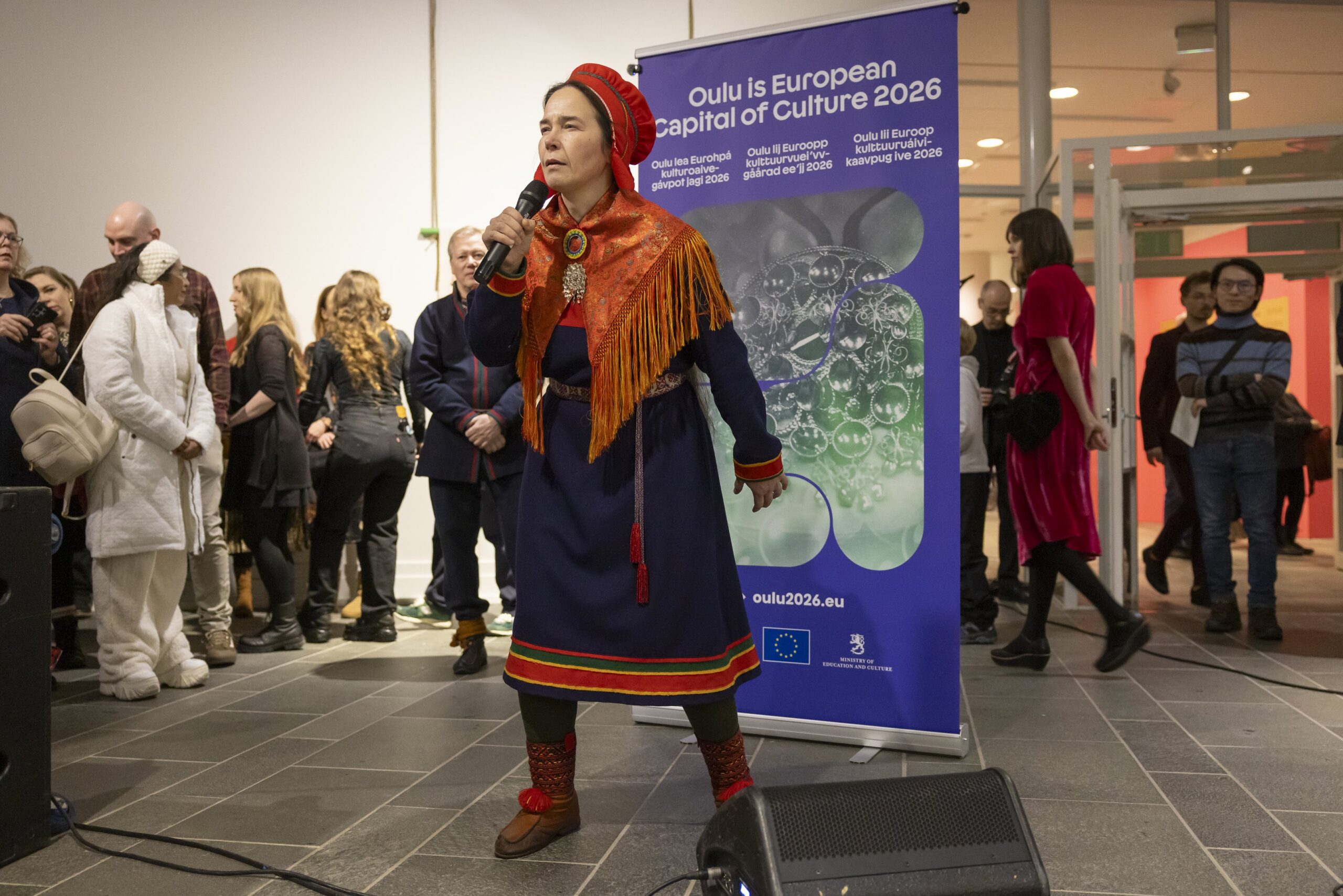
The festival opens on Tuesday, 3 February at 19:00 with a concert by Hildá Länsman and Tuomas Norvio at Cultural Centre Valve. Länsman is one of the most powerful contemporary voices in Sápmi and a proud practitioner and ambassador of the luohti singing tradition. Norvio is a Finnish sound designer, composer and producer. Together with video artist Alice Marie Jektevik, they have created a modern concert experience that opens gateways to both the past and the future. Tickets are available via Lippu.fi.
On Thursday, 5 February at 19:00, Wimme & Rinne will perform at the Pikisali Hall of Oulu City Theatre. Sámi artist Wimme Saari is a master of traditional joik and has developed a distinctive modern style influenced by contemporary music. Together with musician and composer Tapani Rinne, he has performed internationally for over 25 years. The concert is sold out.
Three concerts on the Sámi National Day
On the Sámi National Day, 6 February, the programme features three concerts. The day begins at 16:00 at Valve’s Paljetti stage with Ante Jalvela, as part of the Culture Fridays programme. Jalvela is a Sámi multidisciplinary artist whose performances combine improvisation, various instruments and vocal expression. The event is open to all and free of charge.
At 19:00, Ingá-Máret Gaup-Juuso and the Oulu All Star Big Band will present the album release concert Davvi Oktavuohta – Northern Connection at Pohjankartano Hall. Gaup-Juuso is a Finnish Sámi joik singer, vocalist and actor whose work has been recognised at the Sámi Grand Prix. The programme features her music as well as traditional joiks arranged for big band. In addition to Gaup-Juuso, the soloist is acclaimed jazz trumpeter Jukka Eskola, artistic director of the Oulu All Star Big Band. Tickets are available via Lippu.fi.
The National Day concludes at 21:00 at Cultural Centre Valve with a concert by AMOC & Áilu Valle. AMOC is the first artist to perform rap music in Inari Sámi, while Áilu Valle is a well-known rapper from Inari who primarily performs in Northern Sámi. The duo are currently working on a collaborative album. The concert is all-ages and free of charge, but tickets must be reserved in advance via the Oulu2026 online shop.
On Saturday, 7 February at 18:00, Anna Morottaja & Tallari and Suõmmkar will perform at Cultural Centre Valve. Inari Sámi artist Anna Morottaja, also known as Karhu-Pekan Anna, has revived the nearly lost livđe tradition and now joins forces with Finnish folk music legend Tallari. Suõmmkar combines Skolt Sámi traditional music — including leu’dds, quadrilles and lullabies — with contemporary world music. The concert is part of the OMJ Jazz & Etno series. Tickets are available via Lippu.fi.
Joik in an exhibition, films, opera and a podcast
During Dálvemánnu, the Oulu Art Museum offers a unique opportunity to experience the Eanangiella exhibition, which combines Sámi art and duodji. On Wednesday, 4 February at 17:00, the exhibition visit will be accompanied by Wimme’s joiks. A guided tour in Northern Sámi will take place on Thursday, 6 February at 17:00, and a Finnish-language tour on Sunday, 8 February at 14:00. The tours are included in the museum admission ticket. The exhibition is open from Tuesday to Sunday until late April / early May.
The indigenous film festival Skábmagovat, held annually in Inari, brings three screenings to Oulu during Dálvemánnu. Kayara – Fearánat Inkariikkas, an animated children’s film dubbed and subtitled in Northern Sámi, will be screened at Valvesali on 4 February at 18:00 with free admission. The feature film Ciao ráhkis / Ciao Dear (Finnish subtitles) and the short film screening Suoivanis čuvgii – Emerging from the Shadows (English subtitles) will be shown at Cinema Star on 8 February. Tickets are available from the cinema.
On the Sámi National Day, a new episode of the Mii gullo…? podcast will also be released. The Finnish language podcast, hosted by Sámi freelance journalist, DJ and University of Lapland project planner Eleonora Alariesto, explores Sámi culture with insight, humour and curiosity. Ten episodes will be published during the year on the Podplay platform.
What is Dálvemánnu?
In Northern Sámi, dálvemánnu means “winter month”. Traditionally, the Sámi year consisted of 12 full months plus an additional half month, totalling 13 months. One of these was called dálvemánnu or gáranasmánnu. Today, Dálvemánnu has taken on a new meaning as a gathering of diverse cultural events.
The European Capital of Culture Year strengthens Sámi culture
According to Aino Valovirta, Sámi Culture Programme Coordinator of Oulu2026, the Sámi cultural programme aims to offer visitors to the European Capital of Culture high-quality and diverse experiences while introducing wider audiences to the richness and beauty of Sámi culture.
“On the one hand, we want to highlight our culture and the Sámi people living in the European Capital of Culture area. On the other, we want to bring Sámi people together, offer opportunities to enjoy Sámi culture, and strengthen networks so that organising events will be easier in the future,” Valovirta says.
The Oulu2026 Sámi cultural programme also includes Ovllá, an opera composed by Cecilia Damström, performed on the main stage of Oulu Theatre until the end of February. During Dálvemánnu, performances will take place from 4 to 7 February.
The Oulu2026 Sámi cultural programme is supported by the Finnish Cultural Foundation and produced by a wide network of partners. Oulu is the largest Sámi village in Finland. More than half of the approximately 10,000 Sámi people living in Finland reside outside the Sámi homeland, and around 1,000 of them live in the Oulu2026 area.